DreamPose3D: hallucinative diffusion with prompt learning for 3D human pose estimation
DreamPose3D estimates 3D body motion from sequences of 2D joint positions. It combines action cues and joint relationships with temporal modeling to address ambiguous poses in video.
The research problem
Many 3D pose estimators lift 2D joints frame by frame. A single 2D pose can correspond to more than one 3D arrangement, especially when joints are hidden or video observations are noisy. Motion across frames and the likely action provide additional context.
How DreamPose3D uses that context
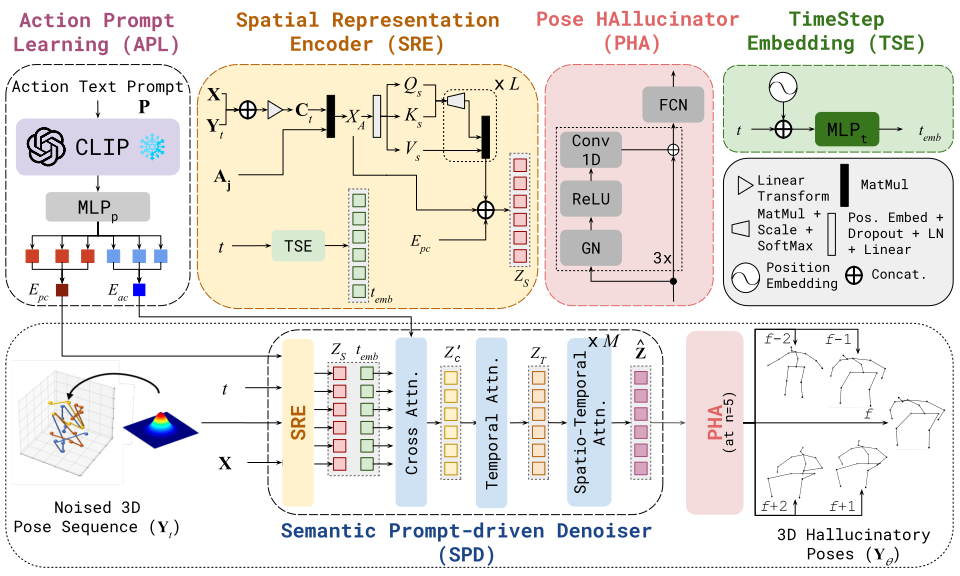
The method extracts action-related prompts from a 2D pose sequence and uses them to condition diffusion-based 3D pose estimation. Its representation encoder also models kinematic relationships between joints. During training, a hallucinative pose decoder predicts coherent pose sequences to help resolve motion ambiguity.
Where it was evaluated
The paper evaluates the method on Human3.6M and MPI-3DHP and tests it on broadcast baseball video with noisy 2D inputs. Read the paper for benchmark protocols, quantitative results, and limitations.
Related baseball video research
PitcherNet examines pitcher tracking, 3D pose, and pitch measurements from broadcast video. It provides another view of the challenges posed by small, fast-moving athletes in game footage.